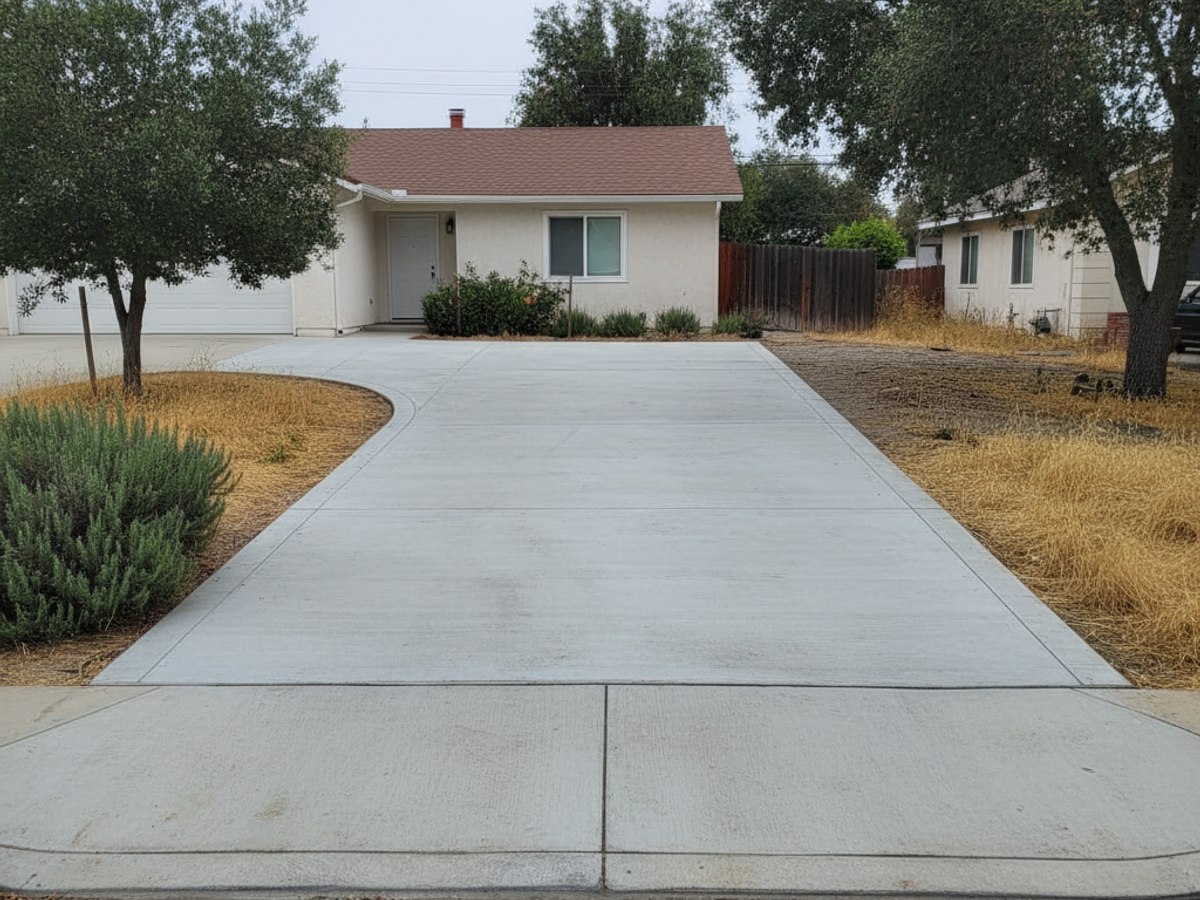
Most people assume concrete just needs to stay above freezing to cure right. In San Mateo that's rarely the problem. We don't get hard freezes here, so you won't see the cracking that comes from water expanding inside a slab overnight like you would in Denver or Chicago. What actually drives the calendar here is rain, and to a lesser extent, fog.
Why the rainy season narrows your options
San Mateo's wet months run roughly November through March, with the heaviest rain usually landing in December and January. Fresh concrete and rain don't mix. If rain hits a slab within the first 24 hours, before it's set up enough to shed water, you get a weak, pitted surface. The cement paste washes to the top, the aggregate doesn't bond right, and you end up with a slab that spalls and dusts years before it should. We can tarp a pour overnight if a storm sneaks up on the forecast, but tarping a 400 square foot driveway in a downpour isn't something anyone wants to do, including us.
It's not just the pour day either. Excavation and subgrade prep go sideways fast when the ground is saturated. Compact a wet subgrade and it looks fine until it dries out and settles unevenly underneath your new slab. That's a callback waiting to happen. So the real dead zone for flatwork here isn't a single day, it's any stretch where the ten-day forecast has more than a 30% chance of rain.
Fog is a different problem than heat
If you've had concrete poured in Fresno or Sacramento in July, you know the issue there is the opposite of ours. Concrete that cures too fast in high heat can crack from rapid moisture loss, so crews are out there misting slabs and racing the sun. San Mateo sits in the fog belt. Our summer highs usually sit in the mid-60s to low 70s, with marine layer burning off late morning most days from June through August. That slower, cooler cure is actually good for strength development. Concrete that cures slowly and evenly ends up denser and less prone to surface cracking.
The tradeoff is timing for finish work. Stamped concrete and exposed aggregate both depend on hitting a narrow window where the surface is firm enough to work but not fully set. Heavy fog and high humidity push that window later in the day, sometimes by an hour or two, which matters when you're trying to stamp a pattern across a 600 square foot patio before it starts going off on you unevenly.
What's actually under your slab
Soil here isn't one thing. Closer to the bay, in areas like Shoreview and parts near Foster City, you're dealing with bay mud, soft, compressible, high water table. That ground needs real compaction and sometimes over-excavation before any slab goes in, or you'll see settling cracks within a couple years. Up toward the hills, Hillsborough and parts of San Mateo Park sit on clay that expands when wet and shrinks hard in the dry months. A slab poured on untreated expansive clay will crack along predictable lines as the ground moves under it season to season. That's one reason we run rebar instead of just wire mesh on driveways and any slab doing structural work, and why control joints get cut within the first 24 to 48 hours after the pour, while the concrete is still soft enough to cut clean and before it decides where it wants to crack on its own.
None of this is really a seasonal issue, it's a soil issue that shows up no matter when you pour. But wet-season excavation makes clay and bay mud both harder to read and harder to compact properly, which is another strike against the winter months for anything beyond small repair work.
Permits don't run on a calendar, but plan around them anyway
The City of San Mateo issues permits for most flatwork over a certain size and for any foundation or retaining wall work, and inspections typically happen at two points, before the pour to check rebar placement and forms, and sometimes after for finished grade and drainage. If your property is unincorporated county land instead of city, it runs through San Mateo County's building division instead, with a similar two-step process. Either way, plan for a few weeks between application and inspection sign-off, longer if your project needs a setback check because it's close to a property line, which comes up a lot on older lots in Central San Mateo and Baywood where houses were built close together in the 1940s and 50s. None of that changes with the season, but if you're trying to hit a dry stretch in October, you want the permit already moving in August, not two weeks before you want to pour.
So when should you actually book the work
Late spring through early fall, roughly April into October, is the stretch that gives you the fewest rainouts and the most predictable schedule. September and October are often the sweet spot, the fog has mostly backed off by then, days are still long enough for a full cure window, and you're not fighting anyone else's holiday schedule the way you are in November and December. That said, small repair jobs, a cracked walkway slab or a chipped step, don't need to wait for ideal weather. If your concrete is already failing, getting it fixed now beats leaving it to get worse through another wet winter.
A full driveway or foundation pour is worth timing around. A patch job usually isn't worth putting off. If you're not sure which category your project falls into, that's the kind of thing worth a quick look in person before you lock in a date. You can see the range of work we handle, from repair to full driveway and foundation jobs, through Paramount Concrete.