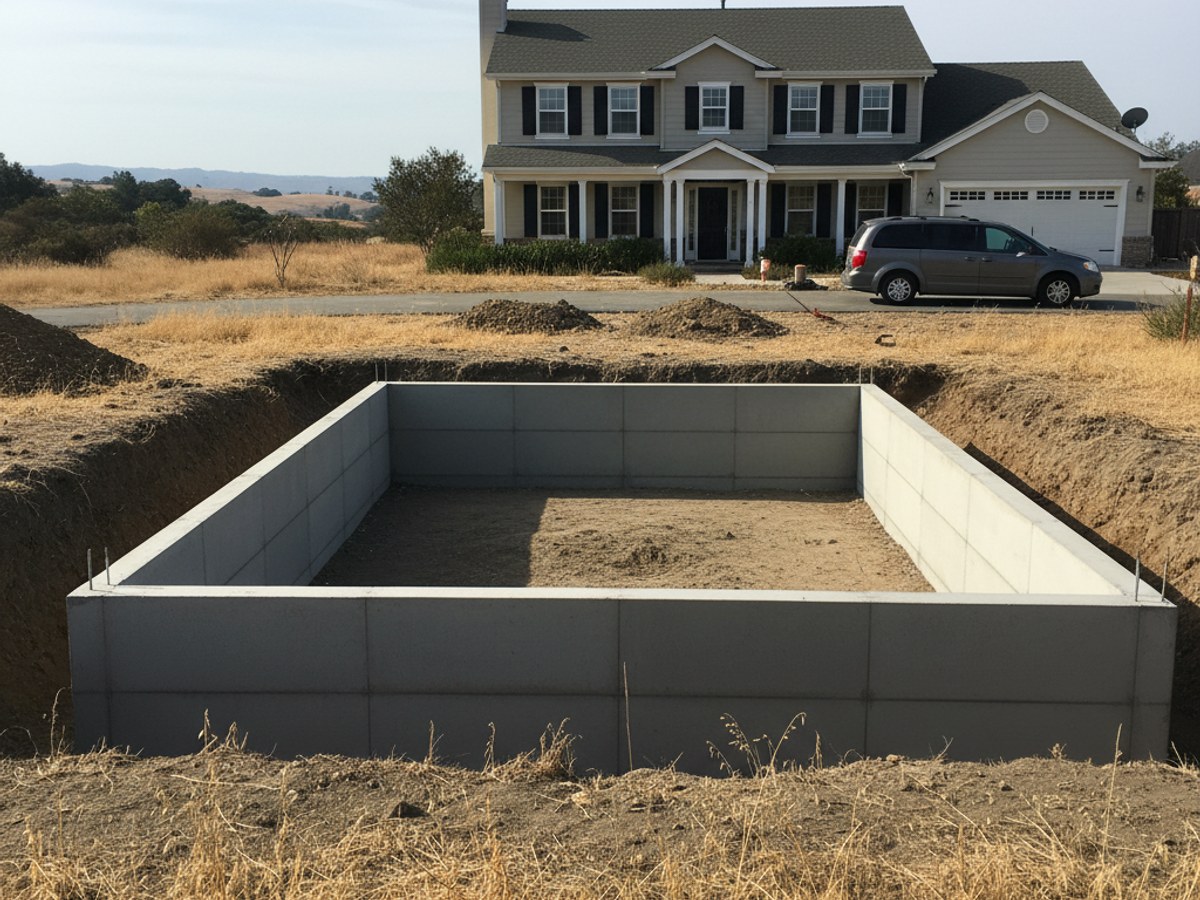
Concrete looks simple once it's down. Gray, flat, done. What determines whether it lasts twenty years or cracks apart in five happens before the truck ever shows up. San Mateo has enough variation in soil, slope, and building age across a few square miles that a checklist for Baywood doesn't fully apply in North Shoreview. Here's what's worth looking at before you sign anything.
What's actually under your lot
San Mateo sits on a mix of ground conditions depending on how close you are to the Bay. Lots near the Bayfront, Shoreview, and the flats east of El Camino often have bay mud or soft clay under a few feet of fill. That soil compresses under load and holds water, which is exactly what you don't want under a driveway slab or a footing. Up toward the hills, in areas like San Mateo Park, the Highlands, or toward Hillsborough, the ground tends to be stiffer clay and more stable, but clay still swells wet and shrinks dry, and that movement is what pushes slabs and causes hairline cracking over a few seasons.
If your property is on fill, newer construction in Bay Meadows is a good example since that whole neighborhood sits on the old racetrack site, which was graded and compacted for development. Compacted fill isn't automatically bad ground, but it needs to be checked and compacted properly before anything structural goes on top, not assumed fine because the lot next door was fine.
Where the water is going to go
San Mateo's rain falls mostly November through March, and it can come hard in a short window. Every driveway, patio, or walkway you pour changes how water moves across your lot, because you're replacing ground that absorbed some of it with a surface that sheds all of it. A slab needs a cross-slope, usually at least a quarter inch per foot, pitched away from the foundation and toward a drain or the street, not toward your neighbor's fence line. On flatter lots near the Bay this matters even more, because the storm drain system in those older streets wasn't built for a lot more hardscape dumping water into it faster than it used to.
Walk your yard during the next real rain, if you haven't already, and watch where the water actually pools. That tells you more than any drawing will.
Which permit applies, and there might be two
A lot of homeowners assume one permit covers the whole job. In practice, concrete work in San Mateo can touch two different processes. A foundation, a retaining wall over a few feet, or a slab replacement tied to the house usually goes through the City's building permit process, with inspections at the forms-and-rebar stage before the pour and again after. A new driveway apron, curb cut, or sidewalk section that touches the public right-of-way is a separate matter, handled through an encroachment permit with the Public Works side of the city, because that strip of concrete in front of your house technically belongs to the city, not to you.
Retaining walls deserve their own mention. Once a wall gets past roughly four feet in height, most jurisdictions start requiring an engineer's stamp on the drawings before a permit gets issued, and San Mateo is no exception to that general rule. If your contractor isn't asking about the wall height before quoting the job, that's worth a question.
HOAs aren't universal here. Older single-family neighborhoods like Baywood, Hayward Park, and San Mateo Park generally don't have one. Some of the newer townhome and condo developments do, and those often want a design review before you touch the driveway or the front walk, separate from anything the city requires.
What's already buried in the yard
Houses in San Mateo's older neighborhoods mostly went up between the 1920s and the 1950s, and a lot of the original sewer laterals from that era are clay pipe, which cracks and shifts over the decades. Before you pour a slab over or near where a lateral runs, it's worth knowing its condition and its path, because digging up a driveway two years later to fix a sewer line is a bad way to find out you should have checked first.
Tree roots are the other common issue on older lots. Coast live oaks and mature redwoods send roots a long way looking for water, and those roots don't stop at a property line or a sidewalk edge. A root under a walkway will lift a 4-inch slab over time no matter how well it was poured. If there's a large tree within fifteen or twenty feet of the work, that's a conversation to have before the forms go up, not after the slab cracks.
The reinforcement and the schedule
Ask what's going in the slab before it's poured, not after. A patio or walkway typically runs #3 rebar on a grid, or sometimes just welded wire mesh if the load is light and the sub-base is solid. A driveway carrying a vehicle, or a slab tied into a foundation, generally wants #4 rebar and a thicker pour, often 5 to 6 inches instead of the 4 inches typical for a patio. Mesh alone under a driveway is a common shortcut that shows up later as cracking along the wheel paths.
Control joints should get cut within the first day after the pour, usually every 8 to 10 feet, because the slab is going to crack somewhere as it cures and shrinks, and the joints decide where that happens instead of leaving it to chance.
On timing, don't plan to walk on fresh concrete for at least 24 to 48 hours, and hold off driving on it for about 5 to 7 days minimum, longer if the weather's been cool and damp, which it often is in a San Mateo winter. Full strength takes closer to 28 days, which matters if you're planning to put something heavy on it, like a loaded planter or a parked trailer, right after the job wraps up.
None of this is complicated once you know to ask about it. Most of it just needs to come up before the pour, because concrete doesn't give you a second chance the way some other materials do. We go through all of this with homeowners before we start, and you can see the kind of work we do at Paramount Concrete.